A Whiteparish local history page from younsmere-frustfield.org.uk
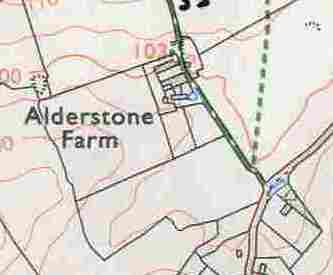
Dating from 1938, Alderstone House occupies the last plot on the right/east side of Dean Lane / Ashmore Lane, as you leave the village going northwards. It stands opposite the entrance drive to Alderstone Farm and next to Ashmore Pond. The garden was set up by the first owner, Dr Wilson-Smith, and lies on the boundary of the Chalk and Reading Bed formations, including areas of chalk, sand and clay (see here for an account of the local geology). Alderstone house is across the road from the entrance to Alderstone Farm and reflects the name of Alderstone manor in which it stands.
See Alderstone House extras for more recent history than that described on this page.
 .
. .png)
Dr Wilson Smith started as the village doctor in 1938 and built Alderstone House because he felt Wisteria House, used by the previous and subsequent doctors wasn't grand enough. The house has a purpose built suite of rooms at the front in which he ran his surgery [Peter Claydon]. Dr Wilson Smith left in 1945, which seems to tie in with 1946, the date of Lord Nye's retirement, but as Lord Nye had a series of further appointments until 1956, that's probably the time he and Lady Nye came to Whiteparish for their true retirement. That also fits with Lady Nye's occupations in the 60s and 70s as described below.
According to Whiteparish - 100 years of an English village, page 130, Doctor Wilson-Smith was also a keen botanist. This book erroneously gives Ashmore House as the location of Dr Wilson-Smith's surgery, rather than Alderstone House.
Lord and Lady Nye (Lieutenant General Sir Archibald Edward Nye and his wife Una Sheila Colleen Nye, nee Knox) moved to Alderstone House when he retired. He had served in the army in both world wars and when he retired on 29 March 1946 had already been appointed Governor of Madras, a post he took up in May and occupied until September 1948. In Madras he was the Colonel-in-chief of the Madras Regiment from August 1946 to March 1949. Lord Nye went on to be the UK's High Commisioner to India from 1948 to 1952, then the UK's High Commissioner to Canada from 1952 to 1956. In retirement Lady Nye was a member of Wiltshire County Council in the 1960s and 1970s. Lord Nye died in 1967 and Lady Nye in 1988 [Lady Nye in Geni.com]. They had one daughter, Harriet Newton-Clare. Lady Nye moved from Alderstone House 1975.
Eric and Jane Legat moved to Whiteparish in 1975 and both took a very active part in village and church life, as Jane still does, each in their turn serving as churchwardens for long periods. After Eric died Jane carried on living at Alderstone House until August 2015, when she sold it and moved within the village; she is still very active in the community [written 2023]. There are some lovely pictures of the interior, exterior and garden here on Zoopla [this link no longer works, but the pictures have been saved and are viewable below for private login to the website]. When Eric and Jane moved in, Kemish the carrier moved their belongings in some 18 journeys.
.png)
.png)
.png)
.png)
.png)
.png)
.png)
.png)
Alderstone House in 2015 (only visible for private login to the website)
Jane Legat's parents had moved to Whiteparish when her father retired in 1949. They bought Oak House, then known as Holly Oak House, and earlier as Barn Close. The plot is shown on the 1842 Tithe Map as part of a rather larger area of land called Barn Close that has subsequently been divided. The maps of 1842 and 2023 below show how the area has been developed. Note that the map on the left is rotated 90 degrees anticlockwise, with east at the top of the map


Left: Barn Close and Ashmore House with its garden, shrubberies and park, in 1842 with east at the top
Right: The same view in 2023 with north at the top. Ashmore House, Stable House and Oak House left of the road, Alderstone House at top next to Ashmore Pond
The manor is described in detail elsewhere in this website (see below for links), but a brief description is appropriate here. The houses of Alderstone Manor were grouped around a village green on the triangular area of land opposite the church that now includes The Triangle. The Manor House stood to the south of the church, partly across the lower part of the present day churchyard and partly across what is now the Memorial Ground car park. Alderstone Farm is an early 17th century farm established on some of the arable fields of Alderstone Manor. The farmhouse dates from the early 17th century with additions from the 1840s. Further details of the present farm can be found here, and an account of the Tithing and Manor of Alderstone here.
With thanks to Peter Claydon for information quoted above, taken from his talk to the Whiteparish Local History Society on 16th February 2010 about the development of the doctors' practice.
Thanks too to Jane Legat for lots of additional information about the history of Alderstone House and Oak Lodge and the people who lived there.